From workmate to Metalwork-mate

When a workmate goes heavy metal

For a bit of outdoor practice welding, I made a wooden mount to securely hold a vise to an old workmate.

First step: gather up some scrap lumber to make a nice base that the top surface of the workmate can really grip into. No movement up or down.

It’s ugly but it’s solid. Yes, those old workmates were still made in Canada.

The problem: after a bit of sparking and arc-ing and metal melting, there are some nice scorch marks on the mount. Not good. I’d like that old workmate to last.

Fortunately, there are some other scraps around. Metal and wood.

First step: cut out a thick piece of board to make it a nice rigid surface. Build up the underside the same way as the vise mount in the pictures above so that it has a nice, strong hold from the workmate.

Pro tips:

  • Open the workmate as wide as it will go
  • The bottom support board that will go under the workmate top should be just a bit narrower than the widest opening at the top of the workmate. That way it can slide through
  • The middle pieces should be about 1″ inside that board (see first picture of the vise mount above).
  • So the top surface board in the picture above will be about the width of the workmate surface once it’s closed up to grip the mounting pieces underneath. That will be about 2″ less than the width of the workmate when completely open.

Next: some scrap sheet metal. What I had on hand is a little too thick for the metal shear in our home at the DDO. Break out the reciprocating saw with a metal blade. Cut to the size or the surface board plus 2 inches on each side.

That saw leaves some rough edges. File’em down.

Next, take it to the metal brake to bend the edges. 1 inch on each side. Did I mention we have an awesome metal brake at the DDO?

Perfect! A nice top that covers the edges.

Drill a few holes for mounting things.

Yeah, yeah, I know. The vise is mounted a little inboard. Did that on purpose for more stability. The workmate is not the most stable thing in the world. I can add another set of mounting holes later.

That worked nicely. So why not take it a step further for even more versatility??

There you have it – the Metalwork-mate.

Now I can get back to more welding practice. I need it, as evidenced by the hardy hole I welded to the end of the anvil.

Closer inspection of the weld on one side of the base indicates a little too much power applied. The hardy-hole hole.

Oh well. At least I have a nice workbench for more practice.

The Great Canadian Antenna

Can it get anymore Canadian than this?

Long-time members and readers may remember the Great Canadian Alligator Clip and how we put it to good use keeping some librarians nicely grounded.

What could we do for a patriotic encore?

The answer came to us from ylab friend John/VE3IPS. We were storing some old radios in a shed, and sent him this picture.

John’s reply: “Luv the snow shoe antenna….40m is open. Work some”

40 metre? At that length? John may be the McGyver of antennas, but in this case, he’s out of his mind… in a different way than he’s usually out of his mind,

Nevertheless, challenge accepted.

A quick measurement of the length, a basic calculation, and we figured that the pair was not to far from the ideal length for a 6 metre dipole.

The tails of the snowshoes are hollow, and just a bit smaller than a half-inch bolts diameter. Perfect. The magnesium is so soft that with just a bit of torque, the bolts nicely tap themselves in.

From there, strip some coax and tie in the ends of both shoes

Now bolt the shoes to a stand.

, and we have something that looks… nah, I can’t call this reasonable.

We hooked it up to our handy little nanoVNA, and it gave us an initial SWR of 4.4. But that’s down in the basement, too close to other metal object. Tighten the connectors, a bit more jiggery-pokery of the cables, better location and we got it down to 2.3. Best result, as predicted, is on the 6 metre band.

Another radio friend John/VE3BOF brought in a more expensive SWR meter and confirmed the 2.3 measurement. And being the nice guy he is, he also brought in a radio that supports 6 metre.

We put the antenna outside on a cold snowy evening and to try it out. Sloth, expediency and the lack of a decent extension cable kept the antenna pretty close to ground level.

The results? We were receiving!

Transmitting was another matter. By dumb luck, VE3NRT was on a 6 metre net, operating from about 20 km away. With some repetition, he was able to hear us and make out what we were saying.

We’re guessing the shape of the antenna, what with all the holes and different paths to the tip, made transmitting a bit of a disaster.

Would a higher location make a difference? That research will have to wait until spring. If you look at the bottom right of that last picture, there’s some white stuff on the ground. Those snowshoes are going back to their original use.

Bottom line: if you want an emergency antenna, pack a roll of wire. You’ll dramatically increase your chance of rescue. Unless, of course, you’re in an area where a good pair of snowshoes would help you trudge out of there.

Winter Blacksmithing

Hammered. The metal. Not us.

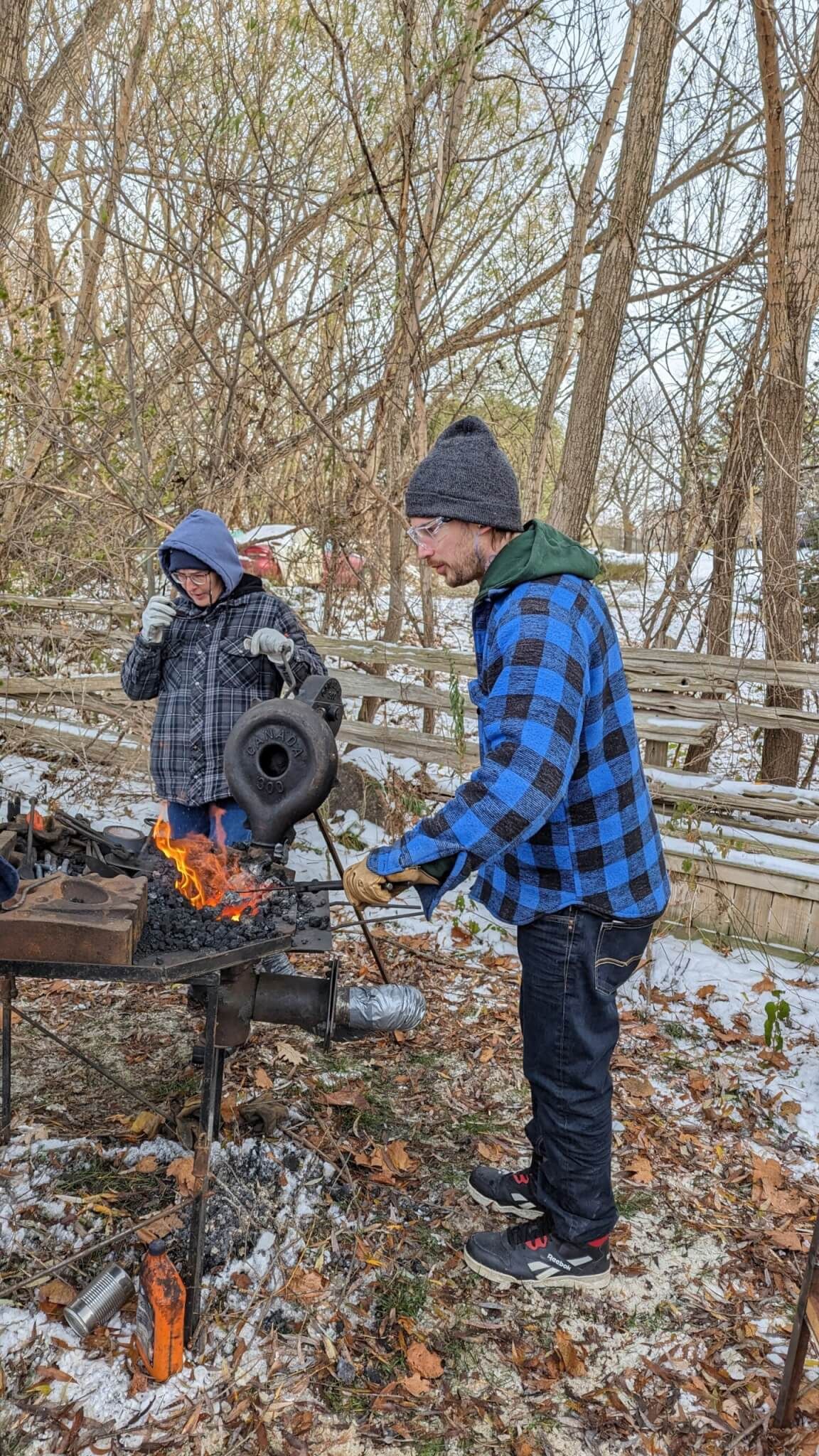
On Saturday November 19th, a few ylab members and friends met up at FireSword Forge in Guelph for an intro to blacksmithing with expert blacksmith David Brandow and our own Metal Master Miro.

Braving the cold and snow was easy – we brought a lot of equipment, with four forges to warm the hands and the steel. Blacksmith Dave provided his outdoor forge, Miro brought two more, and ylab friend Stephen brought a another. Add 7 anvils – enough for everyone to have their own and to put fear in the hearts of the local coyote population – and a pile of tools from Dave and Miro, and we were set for a great day.

A Scout leader can only go so long without a good fire.
Schools open? Schools closed? Tired of the indecision? Get your frustrations out by hammering on something.
Anvils and stands we made at Ylab took the hammering!
File this one under fun day at the forge.
Forges much hotter than normal campfires. Never seen a marshmallow burn that fast off the stick
Applied Materials Science. Gotta hammer in those lessons.
Cranking away. But not cranky.
Cold day. Warm smiles. Would we do this again? Yes we would.

Big thanks to Blacksmith Dave and Metal Master Miro for organising everything, to Miro and Stephen for bringing in so much equipment, to Danielle and Karen for the food shopping and prep, and to all the ylab members who spent the long hours making the anvils.

More equipment! More fun!

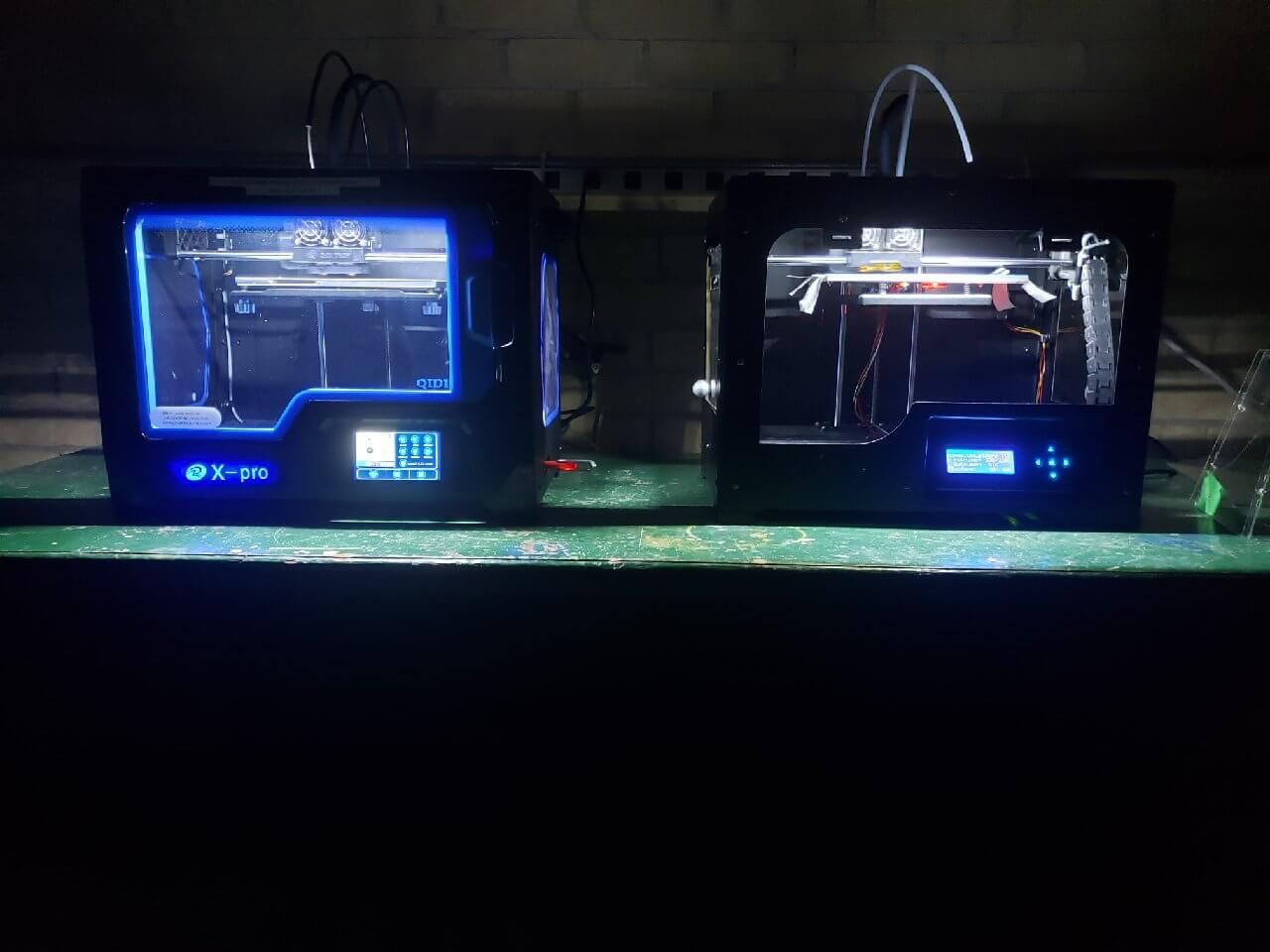
Dual 3D printers. No waiting.

Everything is slowly coming back to life in our evil lair at the David Dunlap Observatory.

As last reported, we spent the first couple of nights getting our popular laser cutter in operation.

We have more equipment donations and loans, and we’re setting those up and shaking them down.

In 3D printers, our reliable Qidi 1 keeps on ticking. Member Craig has provided us with a long-term loan of a better and faster Qidi X-Pro. Both are back in operation and looking fine.

Aw nuts. Well, one small white nut. Hot off the press printer.

We’ve also acquired an old Singer industrial sewing machines and a Juki serger. The pros tell us these oldies are the ones to have. But they needed some TLC and tune-up. Volunteer Eling came in and spent hours getting them back in shape. They’ve been needled, threaded and are ready to go. How serious are these machines? They need oil changes, for crying out loud! Crankcase like a car on both of them!

Our sewing machine tech at work. With respect. Because the machine is older than her.

Someone threw a nice heavy-duty Arrow glue gun our way. Who knew these could clog up so badly that they require disassembly to remove the great gobs of hardened glue?

Glue gun donation. Nothing to sniff at.

On the other hand, it’s good news that the gun can be disassembled and repaired. It’s not just some glued-together, throw-away piece of junk.

We’ll have more updates as we get on to more projects.

What’s been going on: Light sabre tune-ups!

Over the last couple of weeks, we’ve been performing surgery on the light sabres people made in our class several months ago.

All our light sabres can do single or multiple colours. Those multiple colours are way more impressive than the picture shows.

Our light sabres were designed by ylab member Richard. We have  a custom circuit board with low-power ARM processor; multi-colour, 5V high-density LED strips; dual-channel sound generation with  mini-SD card to load sounds; efficient power management; accelerometer to detect movement and collisions, and more.

Upgrading the firmware. Requires a PC and an Arduino board. Because it’s not a maker project if there isn’t an Arduino somewhere in the process.

Our class  included basic soldering for connecting the LED strips; drilling and tapping screw and contact holes for the aluminum hilts; laser cutting the support strips; and all manner of required assembly work.

That first class was a true maker project, with a fair bit of experimentation and lots of learning.

As the first generation design, there were some problems, and we’ve had some repair and rework sessions. Our latest  was on Monday August 20. Repairs included some soldering, taping, software updates and making a splint for a broken support piece. All light sabres brought in left in working condition.

A splice for a broken LED support. Custom made and carved out of Plexiglas on our laser cutter. Most appropriate for a light sabre.

With the oscilloscopes and other equipment we have on-site, we diagnosed a previously unknown power leak that would result in battery drain in 27 days. While that doesn’t sound bad, it’s still a bug. The design expectation was for a year on stand-by. We’re working on a fix. Fortunately, it’s just a software issue.

Testing, testing… with a nice DC power supply that shows current draw.

For those interested in making their own, it will still be a while before we fire up another class. We’re working on  some re-design to make battery changing easier. But we hear you. We’re working on it.

We didn’t finish until late, which is a good thing. Because light sabres look even better in the dark.

Impressive. Most impressive.

Radio Open House: New Faces, New Ideas

Great to see many new faces at our amateur radio open house on Monday, June 25. In addition to the presentation and discussion around the various aspects of amateur radio, we had a great group of people from Toronto Mesh.  

Directional antenna for mesh networks.

They are active in several areas of distributed mesh networks, and are putting a lot of effort into getting people educated. Some of them are playing a part in the our networks conference from July 13-18 that includes 2 days of seminars and 3 days of code sprints.

In addition to some classic ham radio decks, we showed off some really inexpensive technology like SDR (software-defined radio) USB sticks. Originally designed for terrestrial digital television, they can scan a full 6 MHz band, and are available with antenna and accessories for around $25.


Cheapo RTL-SDR USB wideband radio scanner. See the difference between CBC and Virgin Radio?

A copy of our presentation can be found here, and it includes links to the cheap radio sources and ylab Canadian ham certification material we covered in the presentation.

Repent from your unlicensed radio usage! (Actually, just a home-made Yagi-Uda antenna. Yes, that’s a cut-up tape measure.)

We’re looking forward to more radio nights – and our next open house – Drone night – on Monday July 9.

Much improvement and excitement at ylab and the DDO

It’s ylab’s first week back with the DDO now being run by the Town of Richmond Hill, and there are lots of improvements to our space and the entire facility.

While progress appears slow, in the background, the Town’s staff are accomplishing great things.

We mentioned a lot of clean-up in earlier posts.

Invisible, but most apparent: this is our first post written from the DDO since our return. That means Internet access, with a new high speed fibre connection and Wi-Fi throughout.. Yeah, it’s kind of an anachronism in this place.  We’ll live with that. We’ve roamed around the building and it’s excellent everywhere.

Invisible and not so apparent: the building is now hooked up to a better water supply connection and to the municipal sewer system. It was previously on its own septic system.

Invisible and apparent to some of us: a lot of behind-the-scenes reorganisation and clean-up. There are equipment rooms that the public doesn’t get to see. With ylab’s early access while a lot of the work is still happening, we see a huge difference.

All cleaned up and ready for lectures and classes.

With two rooms dedicated to ylab, we’ve reorganised things a bit. Our main room is now set up to double as a seminar room. We can run lectures and classes in there for smaller groups.

The opposite end of the main room. Tools back up on the rack soon. Yes, that’s an upside down monitor on the floor. It’s gone now.

It’s practical to do this without affecting member project work because we now have a separate workshop dedicated to ylab. We’ve cleaned up and reorganised things for the return of our laser cutter next week. We have lots of workbench space at one end, and more storage.

The workbench in the workshop. Table and chair all ready for laser cutter control.

We can work there while the seminar happens in the other room, and vice versa. We will be keeping the messier stuff in the workshop and the main room should not have anything dirtier than soldering.

And all those historic machine tools. So cool even when not used.

At the other end, we find the historical machine tools. We can’t use them, but they look awesome. They inspire us.

Another benefit of ylab’s early access is getting to hear about everyone else’s plans. There are lots of announcements coming soon from the Town and from the astronomy groups coming into the building. But that’s for them to talk about when they are ready.

You can feel the pride in the Town staff and everyone involved. The excitement is building for the DDO to be better than ever with more public access than ever.

First night clean-up turns into archeological dig

Having a maker space in a historical building is so cool.

After many months absence, our first night back at the DDO was dedicated to some clean-up. A new part of ylab is  the DDO’s basement workshop, so we decided to attack it first.

Knows what these are, and can tell some parts are missing.

Getting into some of the old tool cabinets proved… interesting. Years of crud? Par for the course. Mysterious machine tools? Not to some of our members who are skilled with that kind of equipment.

First aid kit. No expiry dates. Guess it’s safe to use.

Then we started finding some pretty nifty old artifacts. Like an ancient first aid kit that still contains ether and castor oil. We found a saw in the same cabinet. Maybe they were prepared for amputations. The DDO was pretty remote in those days.

Wait a minute – those are the missing parts!

Some interesting documents had fallen under the cabinet drawers. Things like blueprints that are actually blue for an old water system. Income tax papers from the War Department, from back when income tax was originated to pay for the war. And some missing parts for some of the machine tools.

Keep going. Maybe we’ll find some other cool stuff. And that big vac needs to be emptied. Again.

We’re logging all this stuff and we’ll be passing it on to the appropriate Town of Richmond Hill staff.

Great to see members Art, Craig, Nick, Richard and Ross again and big thanks for all their clean-up work.

NOTE: use of the DDO machine tools is not permitted for ylab. Doesn’t mean we can’t clean things up. No metal or members were harmed.

Arduino open house notes + hands-on class info

We had a great group show up for the Wed Oct 12 Arduino: What’s It All About? open house. Big thanks to members Jack, Richard, Pek, Ross and Paul for bringing in and sharing their creations, and as always, to Jay for loaning his light sabres.

We’re caving to popular demand and finally scheduling an Arduino hands-on class. It will be taught by ylab member and robotics guru Paul. Registration is open on Eventbrite, and seats are limited. You have the option of bringing your own board, or we’ll provide one.

We had some excellent feedback and comments from last night’s talk.

If you’re interested in using LED strips: check out this interesting tutorial on  YouTube. This applies to the APA102-type LED strips. It’s different for APA104.

LED and  powertail in parallel: our presenter mentioned that when linking the 120V powertail and LED in parallel, there wasn’t enough current to run both. Comment 1: this wasn’t required. It was out of laziness. There are lots of other outputs on the Arduino board. Comment 2: Paul advised that it’s probably not a current issue. The D in LED is for diode, and the diode typically limits the voltage across its terminals to something under 2 volts. This is not enough to trigger the powertail’s relay. We’re breaking out the voltmeter to test that.

Pull-up resistor for switch control: check out this excellent video explaining why you need a pull-up or pull-down resistor when using a push-button switch on Arduino digital pins.


Don’t forget to register for our next open house – the great 3D Printing vs Laser Cutting debate on Wed Oct 26.

Comments? Feedback? Post it on facebook.


AGM: Of Course We’d Like Fries With That!

Ten minutes ago, these were potatoes.

Ylab held its first member’s Annual General Meeting on June 20 at the DDO. How do you get a bunch of makers to actually show up for a boring meeting? Hold a BBQ!

Can we be any clearer that it's a ylab BBQ event?
Can we be any clearer that it’s a ylab BBQ event?

July 25 is the anniversary of our first event, so it’s not quite a full year. Fiscal year end is March 31 because our volunteering accounting people have the time now to do all the book closing and reporting stuff  Big thanks to Jenn, Murray, Joel and Wendy for all their work that nobody else wants to do.

Shady characters did the cooking.

Being makers, frozen patties would just not do. Nothing but fresh ground beef. A charcoal kettle. A big vat of boiling oil and fresh cut fries. Bitten tongue was on the menu for those who thought  we would put breadcrumbs or milk-based substances in our burger patties (you know who you are). The nerve.

Boiling oil. Don't piss us off, or we're taking it to the roof.
Boiling oil. Don’t tick us off, or we’re taking it to the roof.

The BBQ was a most pleasant and relaxed event – a warm summer solstice evening, a perfect venue at the DDO, a good breeze to keep carnivorous bugs away from the carnivorous makers, and good company from the invited RASC-DDO members who open the doors for us on our maker nights and do an all-around amazing job.

Turning away from the camera because they ate TWO burgers.

The AGM part was mercifully short. A member vote brought in new board members Pek and Richard. Our eternal gratitude to departing board members Peter and Gary for all their work helping ylab get off the ground.

At the end  of the evening, the usually-dark parking lot was lit by a squadron of fireflies.

And that’s how ylab does an annual meeting.